Where the Assembly Labour Goes
A cabinet is not one product but a stack of small assemblies: a box, a face frame, drawers, doors and hardware. Every one of those assemblies has to be joined by somebody. CasaBuilt's published gauges — a 1/2-inch plywood box side, a 3/4-inch face frame, a 5/8-inch drawer side and a 3/4-inch shelf — are the parts where that joining work either happens in a factory jig or on a kitchen floor.
Key takeaways
- Assembly is a sequence of five joins, not a single task: box, face frame, drawers, doors and hardware.
- The published face frame is 3/4 inch by 1-1/2 inch solid birch, half again as thick as the 1/2-inch box side.
- Drawer sides are 5/8-inch rubberwood with dovetail joints; shelves are 3/4-inch adjustable plywood.
- Flat-pack moves the joins to site; the assembled route moves them to a bench with jigs and repeatable setup.
The five joins in every cabinet
Strip a cabinet back to its operations and the list is short. The box gets joined at four corners. The face frame gets attached to the front. Each drawer gets a box, a bottom and a front. Each door gets a frame, a panel and two hinge cups. The glides get screwed to the box sides and the drawer bottoms. That is the whole job, repeated once per cabinet.
What changes between routes is not the list. It is where each item on the list happens. In a factory, the box goes into a square, the frame goes into a jig, the drawer parts go into a dovetail machine and the hinge cups get bored at a fixed depth. On site, the same operations happen with a drill, a mallet, a square and whatever surface the floor offers.
CasaBuilt ships RTA cabinets flat with hardware and step-by-step guides, plus assembly videos and support. The same catalog also lists built units that arrive with every one of those five joins already made. A buyer is choosing which room absorbs the work, and how many times the work will be repeated.
Gauges that decide who can do the work
The published thicknesses are not marketing detail. They set the tools and the tolerance. A 1/2-inch plywood side takes a certain screw length and a certain pilot hole. A 3/4-inch face frame takes a longer fastener and rewards a clamp. A 5/8-inch drawer side has to hold a dovetail without splitting, which is why the joint is cut rather than screwed.
| Assembly | Published part and gauge | Join that has to happen |
|---|---|---|
| Box | 1/2-inch birch plywood, natural birch interior | Four corner joints, back panel, dado for the shelf |
| Face frame | 3/4-inch by 1-1/2-inch solid birch | Frame assembly, then attachment to the box front |
| Drawer box | 5/8-inch rubberwood sides, dovetail | Four dovetailed corners, bottom, drawer front |
| Shelf | 3/4-inch plywood, adjustable | Shelf pin placement, half-depth shelf in bases |
| Door | Rubberwood frame with MDF panel, full overlay | Frame joinery, panel float, hinge cup boring |
| Hardware | Soft-close concealed hinges, 6-way adjustable | Hinge mounting, then door alignment on the box |
| Finish | 7 layers of paint with UV protective finish | Spray passes and cure time before packing |
Notice how much of the table is boring and how little of it is skilled. That is the point. Assembly labor is mostly setup, repetition and checking, which is exactly the kind of work a factory does faster because the setup happens once and the repetition never stops.
The seven-layer finish is the clearest example. On site, every coat needs masking, a dust-free gap and a place to dry where nothing touches the door. A factory runs the same seven passes on a line where the doors hang on a carrier. The work is identical; the overhead is not.
The joins that come back to visit
Some assembly faults show up immediately and some wait. A door hung a millimeter out of alignment is obvious on day one and can be corrected with the six-way adjustable hinges. A drawer box that is slightly out of square binds for a year, then the glide wears and the drawer starts to rub. A box joined without a true square shows up at installation, when the cabinet will not sit flush against its neighbour and the filler strip has to cover a gap that should not exist.
This is why the assembled route appeals to people who have already built a kitchen once. The cost of a rework is not the part; it is the second visit, the second delivery and the lost weekend. CasaBuilt publishes a one-year warranty covering manufacturing defects in materials and workmanship under normal residential use, which is the backstop when a join fails rather than a substitute for making it properly. The terms are set out in the published warranty policy.
For a buyer assembling flat-pack units, the equivalent protection is a routine: build on a flat surface, check the box diagonally before the glue sets, and test every drawer before the cabinet goes against the wall. Most flat-pack faults are detectable in the first ten minutes of the build, while the fix is still a screwdriver rather than a phone call.
Who should build, and when
The honest answer depends on the count. One cabinet, one evening, one person with a drill and a clear floor: the flat-pack route is a reasonable trade of time for money. Twenty cabinets across a kitchen and a laundry, with a deadline and a tradesperson waiting: the same arithmetic that makes DIY sensible at one unit makes it expensive at twenty.
There is also a skill question that buyers tend to skip. Hanging a door so it closes with an even gap is a feel, not a measurement. A factory jig reproduces that feel every time. A first-time assembler reproduces it on the fourth or fifth attempt. If the kitchen has 14 doors, the learning curve is paid for 14 times, and the last door will fit better than the first.
Buyers who choose pre assembled cabinets tend to fall into two groups: those paying someone else to install and who do not want to pay that person to assemble as well, and those in a property where dust and workspace are limited. Flat-pack suits the buyer with time, a garage and an appetite for the job. Neither group is wrong. They are buying different amounts of their own labor back.
One practical note on storage. Flat-pack cartons are shallow enough to stack in a spare room; built cabinets are not. If the delivery lands before the room is ready, the assembled route needs a dry, flat wall to stand the units against, and the flat-pack route needs a corner that stays dry. Both need the cartons kept off a concrete floor that sweats.
Worked example
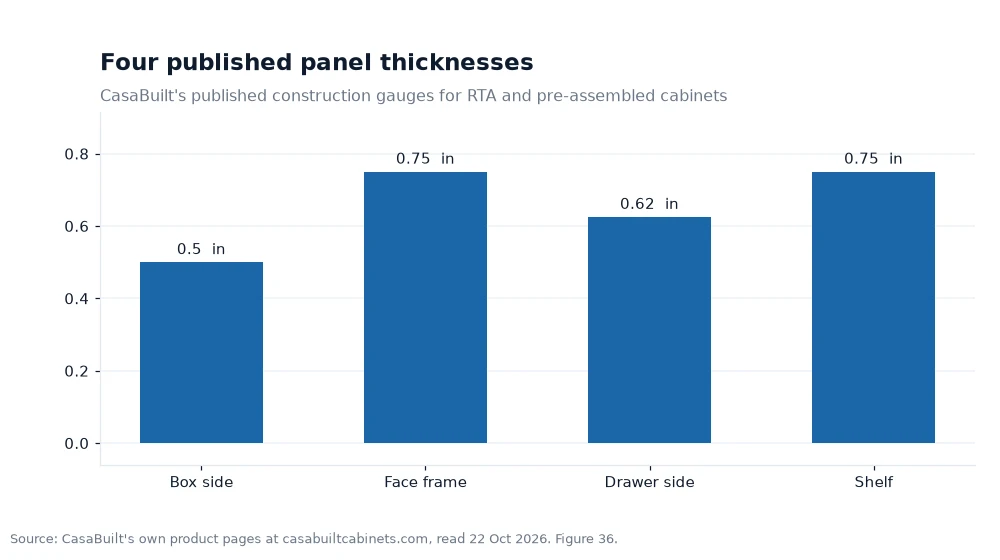
The chart plots four published gauges: box side 0.5 inch, face frame 0.75 inch, drawer side 0.625 inch and shelf 0.75 inch. Read as fractions, those are 1/2, 3/4, 5/8 and 3/4 inch.
Compare them. The face frame is 0.75 minus 0.5, or 0.25 inch thicker than the box side, which is a 50% increase (0.25 divided by 0.5). The drawer side is 0.625 minus 0.5, or 0.125 inch thicker than the box side, a 25% increase. The face frame is 0.75 divided by 0.625, or 1.2 times the drawer side, so it is 20% thicker again.
Add the four gauges: 0.5 plus 0.75 plus 0.625 plus 0.75 is 2.625 inches of published panel thickness in one cabinet's key parts. Two shelves at 0.75 inch each come to 1.5 inches, which is 4.3% of the published 34-1/2-inch base cabinet height (1.5 divided by 34.5). Small fractions, but they are the difference between a box that stays square and one that racks: the 0.25-inch step from box side to face frame is where the front of the cabinet gets its stiffness, and it is the join a factory jig holds while the glue sets.
Frequently asked questions
Does the assembled route use different parts?
The published construction figures are the ones quoted for the collection: a 1/2-inch birch plywood box, a 3/4-inch by 1-1/2-inch solid birch face frame, 5/8-inch rubberwood dovetail drawers, 3/4-inch adjustable plywood shelves and soft-close hardware. What differs is who makes the joins and where they are made.
How long does flat-pack assembly take per cabinet?
The published site does not quote an assembly time, so treat any per-cabinet estimate as your own. The variable that matters is not the box but the doors: hinge adjustment on a full-overlay door is the step most likely to need a second pass, and a kitchen with 14 doors pays that cost 14 times.
Can a handyman assemble RTA cabinets on site?
Yes, and that is often the sensible middle route: buy flat-packed, pay a carpenter to build and install. The published guides, videos and support exist for exactly that workflow. Confirm the labor rate per cabinet before ordering, because assembly time is the number that decides whether the saving survives.
Decide by counting the joins
Count the cabinets, then count the joins inside them. A single vanity is a pleasant Saturday. A full kitchen plus a laundry is a week of evenings, and the week is the real price of the discount. If the calendar is tight, buy the joins already made.
Either way, check the box before it goes against the wall. Square, level and a drawer that runs true are worth more than any label on the carton, and they are the three things a buyer can verify without a specialist tool.
Figures quoted here come from the manufacturer's own website, read 22 Oct 2026[1].