Home Fragrance Lead Times: What Actually Sets the Calendar
Most of a home fragrance lead time is spent waiting for decisions, not for machines. Production itself is usually the shortest part of the calendar; what stretches a project is a specification that keeps moving, a packaging component with its own long lead time, and a test that has to be booked rather than run. Brands that plan the decision points first and the production window second finish sooner than brands that push for a faster filling date.
Key takeaways
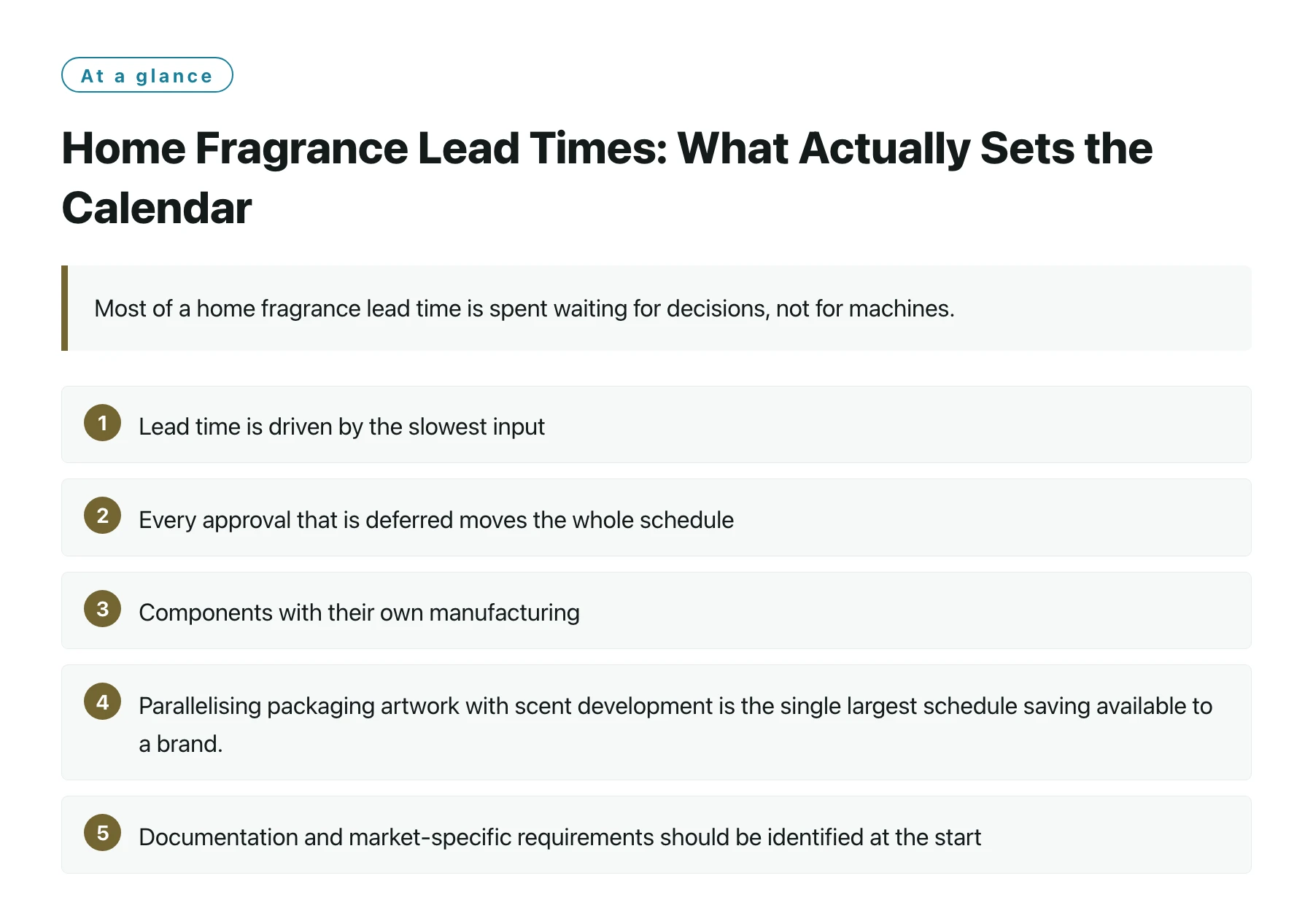
- Lead time is driven by the slowest input, which in home fragrance is usually packaging or a commissioned test rather than filling.
- Every approval that is deferred moves the whole schedule, because development, packaging and testing run in sequence rather than in parallel unless someone plans otherwise.
- Components with their own manufacturing, such as printed cartons or custom glass, set a floor on the schedule that no production efficiency can beat.
- Parallelising packaging artwork with scent development is the single largest schedule saving available to a brand.
- Documentation and market-specific requirements should be identified at the start, because they can add a step after the product is otherwise ready [1].
A home fragrance schedule looks simple on a slide: brief, sample, approval, production, delivery. In practice, three of those five stages wait on inputs that come from outside the factory, and the waits are what the brand actually experiences as lead time.
Breaking the calendar into decisions and dependencies rather than into factory operations makes the real critical path visible, and it usually shows that several things can be done at once.
What sets each wait, and what a brand can do
| Stage | Usually set by | Can a brand shorten it? | How |
|---|---|---|---|
| Specification | The brand's own decision speed | Yes, largely | Write one page, sign it, stop editing it |
| Scent rounds | Brief quality and approval discipline | Yes | Define intensity and reference products in the brief |
| Substrate testing | Physical test duration | Partly | Choose a substrate the factory already runs |
| Glass and carton | Component manufacturer's schedule | Only by choosing standard components | Pick from existing moulds and dielines for a first season |
| Decoration | Setup and drying steps | Partly | Fewer decoration stages on the first order |
| External tests | Laboratory queue and test duration | Not much | Book early and run them alongside production |
| Freight | Route and season | Partly | Book capacity before the product is finished |
Only two rows in that table are truly outside a brand's control. The rest are decisions, which means the schedule is largely a discipline problem rather than a manufacturing one.
The real sequence, with what each stage waits on
- Specification freezeWaits on the brand: application category, dosage target, format, fill volume and price ceiling. Until this is signed, every later stage is provisional.
- Scent development and selectionWaits on the brief and on the number of rounds the brand needs. This is the stage where a vague brief turns into several extra weeks.
- Substrate and delivery testingWaits on the selected oil. Burn or evaporation testing has to run on the production substrate, so it cannot start earlier.
- Packaging tooling and printWaits on the frozen fill volume and closure, then runs on the packaging supplier's own lead time, which is often the longest single line in the project.
- Approved reference and pilot batchWaits on everything above. The pilot batch confirms that the assembly behaves as the sample did.
- Bulk productionWaits on materials arriving together. Filling a home fragrance product is quicker than most brands expect; the delay is normally an incomplete material set.
- Testing, documents and releaseWaits on commissioned tests. Anything requiring an external laboratory should be booked before the pilot batch ends.
The parallelism that saves the most time
Home fragrance projects are usually run sequentially because each stage feels like it depends on the previous one. Some dependencies are real: substrate testing needs the selected oil, and the pilot batch needs the approved packaging. Others are invented. Artwork separation, carton structure design and closure selection can all proceed while the scent is still being selected, provided the fill volume is frozen.
The precondition is that the brand is willing to commit to the parts of the specification that are not scent-related. A brand that cannot decide on a bottle until it has chosen a scent has chosen to serialise the whole project.
It is also worth confirming which stages the factory performs in house and which are handled by partners, because a hand-off is where a day or two quietly disappears. A supplier that describes its own production as the stages of perfume production will normally be able to show the sequence it works to, and that sequence is the realistic calendar rather than an aspirational one.
Materials that move the schedule without warning
Some fragrance materials and some pack components are supplied by a small number of producers, so availability rather than price becomes the schedule risk. Public materials databases are a quick way to see how a material is described and whether substitutes exist [2], and asking a supplier which inputs are single-sourced is a reasonable part of the planning conversation.
Documentation is a stage, not an afterthought
Market-specific requirements can add a step after the product is technically ready, which is why they belong at the start of the plan. Industry coverage of production and supply conditions is a useful way to keep an eye on what is changing in the categories a brand ships into [1], and the factory's own published scope, such as the one on its official website, is the fastest way to see which markets it already documents for.
Ask for the schedule as a list of dated dependencies rather than a single delivery date. 'Where does this date come from?' is the most useful project question in home fragrance, and suppliers who work this way will answer it without hesitation.
Planning the first season realistically
For a first season, the schedule is usually made or lost on component choice. Standard vessels, standard closures and simple decoration move the critical path back to scent development, where the brand has the most control. Custom glass and multi-stage decoration move it to a supplier the brand cannot influence.
A practical approach is to launch the first run in standard components with strong artwork, learn what sells, and reserve custom tooling for the scent that earns it. That is not a compromise on quality; it is a way of spending the schedule on the part of the product customers will actually notice.
Whatever the choice, the calendar should be written once and updated in one place, with the freeze point marked on each stage. In most projects the delays that hurt are not the long waits but the short ones nobody noticed: a label proof sitting unapproved, a fill tolerance confirmed verbally, a test report nobody asked for until the shipment was booked.
Sources
- Cosmetics Business —— A trade publication covering the beauty and cosmetics industry, including fragrance launches and regulatory developments.
- The Good Scents Company —— A reference database of aroma materials with odour descriptions, CAS numbers and typical usage information.
Frequently asked questions
What is the longest part of a home fragrance lead time?
Usually packaging, either custom glass or printed cartons, because both run on another manufacturer's schedule. Scent development can also be long when the brief is vague and several rounds are needed.
Can production be rushed at the end to catch up?
Filling and packing are rarely the bottleneck, so compressing them saves little. If a schedule slips, the recoverable time is usually in approvals and in parallel work, not in the production window.
How early should packaging be ordered?
After the fill volume, closure and delivery system are frozen, and never before. Ordering earlier risks obsolete components, which costs more time than the head start saves.
Do external tests always extend the schedule?
They do if they are booked after production finishes. Booked in parallel with the pilot batch, most commissioned tests overlap with work that was going to happen anyway.
How should a brand track a fragrance project?
As a short list of stages with an owner and a dated dependency for each. A single promised delivery date hides exactly the dependencies that cause the delay.