Common Challenges in Qualifying medical supply manufacturers in China
Medical supply qualification depends on intended use, product category, destination market, manufacturing site, and the evidence tied to the exact item. Buyers should coordinate regulatory, quality, and sourcing reviews before relying on a supplier’s general credentials.
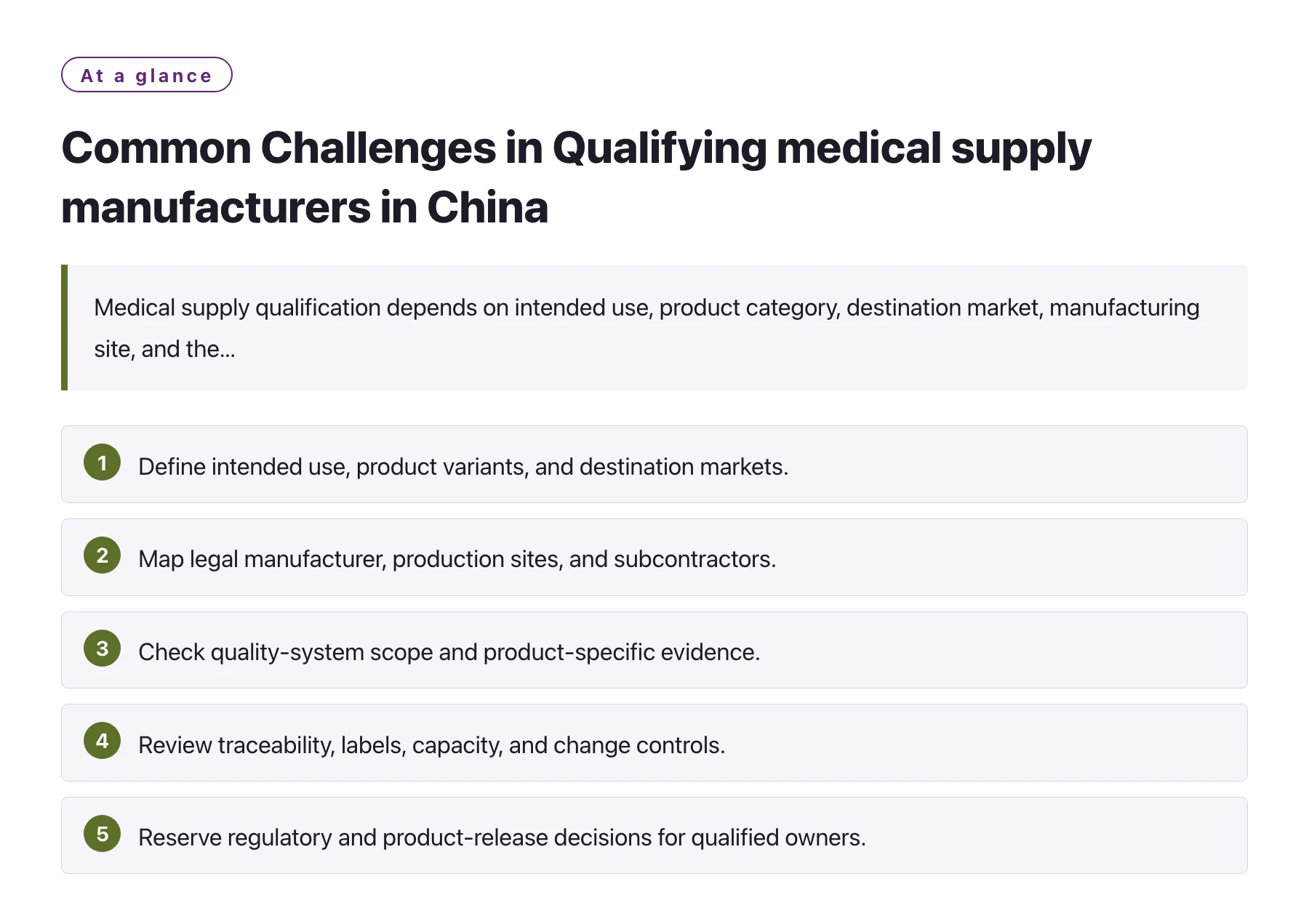
Key takeawaysDefine intended use, product variants, and destination markets. · Map legal manufacturer, production sites, and subcontractors. · Check quality-system scope and product-specific evidence. · Review traceability, labels, capacity, and change controls. · Reserve regulatory and product-release decisions for qualified owners.
Supplier qualification is an evidence review, not a certificate collection exercise. Each document should connect to the exact manufacturer, process, product, and market.
1. Define what “medical supply” means for this order
Medical supplies cover very different products: disposable consumables, diagnostic accessories, protective items, reusable instruments, and regulated devices. Begin with intended use, user, contact type, sterility, shelf life, packaging, and destination markets. Do not assume a factory’s product category or a distributor’s description determines how a regulator classifies the item.
Build a product list and identify which items share a manufacturing process and which require separate supplier or regulatory review. Note materials, dimensions, variants, packaging configuration, and any claims that may affect classification. Have a qualified regulatory owner confirm intended-use language and applicable requirements before requesting final quotes.
2. Establish the regulatory path by market
Regulatory requirements depend on product and jurisdiction. For U.S. imports, FDA states that foreign medical-device manufacturers must meet applicable U.S. requirements, which can include establishment registration, device listing, a quality management system, premarket requirements, labeling, and reporting obligations. Determine the product-specific path with qualified regulatory support rather than relying on a generic certificate. [1]
A supplier serving another country may use different registrations, technical files, quality records, and authorized representatives. Keep market-specific evidence separate and confirm that documents identify the exact product, manufacturer, site, and current revision. Regulatory authorization in one market should not be assumed to satisfy another market’s rules.
3. Verify the manufacturer and production sites
Map the contracting entity, manufacturer, legal manufacturer if relevant, production facility, sterilization site, testing laboratory, exporter, and importer. Ask which steps are performed in-house and which are subcontracted. Confirm that the quoted product and any regulatory documentation refer to the same responsible entities.
Perform proportionate business due diligence on company identity, contacts, address, payment beneficiary, and relevant claims. Verify important information through independent channels and retain records. A trading company may coordinate multiple factories, but the buyer still needs to understand who controls manufacturing and who is responsible for product records and changes.
4. Review quality-system evidence carefully
Request current quality-system certificates and scope, then verify issuer, site, product scope, issue and expiry dates, and any exclusions. Ask for the certificate’s relationship to the actual manufacturing activity. A certificate indicates a defined assessment scope; it does not prove that every product, batch, or requirement conforms.
Review how specifications, suppliers, incoming materials, production records, nonconformities, corrective actions, complaints, and traceability are controlled. Request redacted examples and follow one lot through its records. If the product is sterile or has a defined shelf life, identify the process validation, environmental, and packaging evidence that the qualified quality owner requires.
5. Match test reports to the product and claim
Ask for reports that identify sample name, model, lot, site, test method, laboratory, date, and result. Compare the report to the exact material, dimensions, configuration, intended use, and market. A report for a similar model or previous revision may leave a gap that must be resolved before an order is released.
Separate performance testing, biocompatibility, sterilization validation, packaging integrity, shelf-life evidence, and electrical or software testing as applicable. Not every product needs every test; a qualified regulatory and technical reviewer should determine the evidence set. Avoid interpreting a test summary without its scope, method, and limitations.
6. Control materials, processes, and subcontractors
Identify critical materials, supplier specifications, approved sources, and incoming verification. Ask how the manufacturer prevents substitution and links material lots to finished goods. For a product with sterility or contamination controls, confirm which steps require controlled conditions and what records show routine execution.
List all subcontracted processes and sites, including sterilization, coating, molding, assembly, packaging, and laboratory testing. Define how changes to materials, site, process, or suppliers are assessed and communicated. The buyer should receive notice early enough for regulatory review before changed product enters a shipment.
7. Confirm labeling, packaging, and traceability
Review label content, language, symbols, lot or serial identifiers, manufacture or expiry date, storage conditions, and instructions against the approved market-specific artwork. Assign a qualified owner to approve claims and regulatory wording. Ask how obsolete labels are removed and how mixed revisions are prevented.
Define packaging protection and, where relevant, sterile barrier or shelf-life requirements based on the product’s intended use and applicable evidence. Confirm carton and unit-level identifiers reconcile to batch records and packing lists. For complaints or recalls, the buyer needs a practical path to identify affected lots and distribution status.
8. Assess capacity and supply continuity
Ask whether the factory can support the forecast quantity, ramp schedule, controlled environment, trained staff, key components, and release testing. Separate installed capacity from available capacity and identify the bottleneck process. Review lead times for critical inputs and how the supplier manages shortage or equipment downtime.
Request a continuity plan for key materials, sites, and responsible quality contacts. Assess whether the supplier can preserve records and notify the buyer if an interruption affects product availability or regulatory status. A capable sample run does not by itself demonstrate stable capacity for a recurring programme.
9. Agree audits, inspections, and release controls
Define the purpose and scope of an audit or visit: quality-system review, process observation, document sampling, or order readiness. Agree access, confidentiality, records, and follow-up. A buyer visit or third-party inspection is a point-in-time activity and does not replace required regulatory oversight or supplier controls.
For each order, set incoming or pre-shipment checks that match product risk and acceptance requirements. Name who can release product, accept a deviation, or stop shipment. Keep technical disposition with qualified quality and regulatory owners; do not convert a commercial deadline into a substitute for documented acceptance.
10. Build an evidence-based qualification decision
Use mandatory gates for identity, regulatory path, quality evidence, product-specific test results, traceability, and change control. Then compare capacity, responsiveness, cost, and continuity. Record each open issue, evidence required, owner, and closure deadline; do not bury a critical gap in a weighted average.
Buyers evaluating Shanghai JS Sourcing can use a structured matrix to coordinate manufacturer discovery, document collection, and factory review. Confirm service scope directly and keep classification, regulatory submissions, product acceptance, and release decisions with qualified owners.
Sources
Frequently asked questions
What should I verify before selecting a medical supply manufacturer?
Confirm product scope, regulatory path, responsible entities, quality-system evidence, product-specific tests, traceability, subcontractors, and change control.
Does a quality certificate prove the product is compliant?
No. Check the certificate scope and verify separate product-specific evidence and market requirements with qualified reviewers.
Can I use the same manufacturer documents in every country?
Not necessarily. Requirements and accepted evidence vary by market and device classification; confirm each destination separately.
Who should approve medical-device regulatory claims?
A qualified regulatory owner should review classification, claims, labeling, submissions, and market authorization before commercial release.