CO2 Recovery for Breweries That Want It Back
Every fermentation releases carbon dioxide, and in most small breweries it leaves through a blow-off hose and is never seen again. A recovery plant captures that gas, cleans it and returns it to the process for purging, carbonation and packaging. The question is not whether the gas is there but whether a plant at your scale has enough of it, often enough, to justify the equipment.
Key takeaways
- HGMC publishes CO2 recovery plants as a product family alongside brewhouses, fermenters, filling machines and CIP systems.
- Gas is produced during fermentation and consumed during purging, carbonation and packaging, so recovery is about timing as much as volume.
- A 10 BBL batch is about 1,170 litres, and twelve brews a month means roughly 14,040 litres of beer passing through the plant each month.
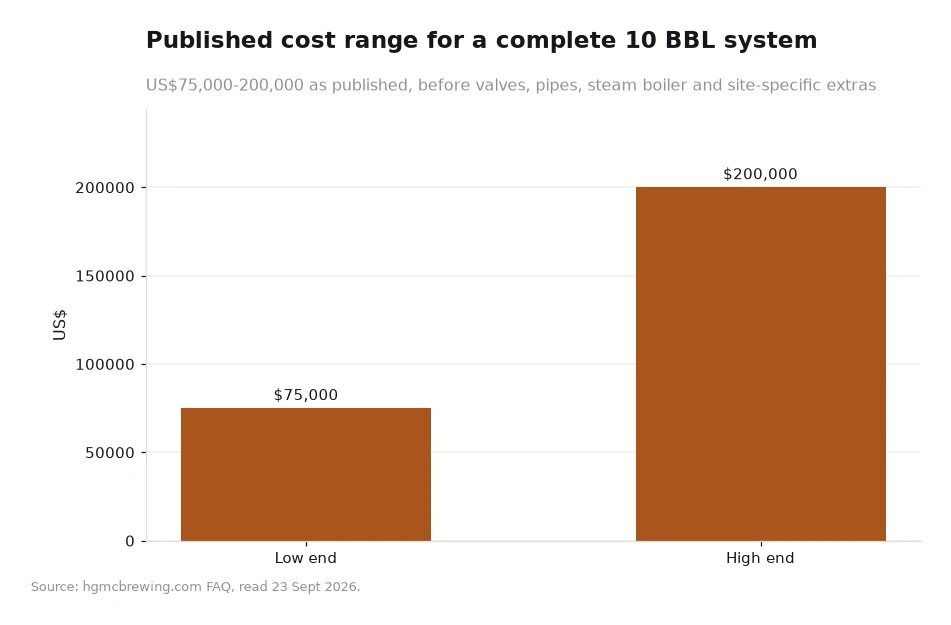
- The published capital reference for a complete 10 BBL system is around US$75,000 to US$200,000 before valves, pipes, a steam boiler and site-specific extras.
Where the gas comes from and where it goes
Yeast converts sugar into alcohol and carbon dioxide. In an open or vented fermentation the gas leaves through the blow-off arm; in a closed tank it can be routed to a collection line instead. That single change, a closed vessel with a gas take-off, is what makes recovery possible at all, which is why the decision belongs with the tank specification rather than with the utilities.
The demand side is just as important. Breweries use carbon dioxide to purge tanks and lines of oxygen, to carbonate beer, to push beer between vessels and to package it. A plant that packages frequently and purges carefully has a steady appetite; a plant that packages by hand in small runs may not.
Recovery therefore works best where supply and demand overlap in time. A brewery that ferments heavily in one week and packages in the next needs storage between the two, which is what the gas holder in a recovery plant provides.
Where a recovery plant fits in the building
A recovery installation is not a single box. It brings together a collection line from the fermenters, a compressor or booster, drying and filtration stages to bring the gas to an acceptable purity, a storage vessel, and a distribution line to the points of use. Each of those needs space, access for maintenance and a route for pipes.
The storage vessel is usually the largest item and the one that decides the room. It needs to stand where it can be inspected, where a relief arrangement can vent safely, and where a service engineer can reach the fittings without dismantling pipework. In a small building, that space often has to be reserved at layout stage, before the tanks are placed.
Piping has to be designed for the gas, not borrowed from the beer lines. Purity standards set the materials and the jointing method, and every extra metre of pipe is another place where a leak can develop. That is one reason the published design service, which covers brewery space layout together with vessel and piping design in 2D, 2.5D and 3D models, is useful on this kind of project: the gas route can be drawn beside the product route before anything is ordered.
When recovery is worth sizing properly
Three questions decide the commercial case. How much beer does the brewery ferment in a month? How often does it package, and in what format? And how much gas does it currently buy or, in some markets, how much does it vent under local rules?
If the answers point to steady production and weekly packaging, a recovery plant sized to the fermentation peak will be earning its keep most weeks of the year. If production is seasonal and packaging is occasional, the same equipment may sit idle for months, and the honest comparison is between the capital cost and the value of the gas it would have bought back.
There is also a resilience argument that has nothing to do with price. A recovery plant with storage gives a brewery a buffer of its own gas, which means a delivery delay or a supply interruption does not halt packaging. For a brewery selling packaged beer on a fixed schedule, that buffer can matter more than the monthly saving.
| Decision factor | Why it matters | What to ask the supplier |
|---|---|---|
| Fermentation volume | Sets the peak gas available | What collection rate suits my batch sizes? |
| Tank type | Closed tanks can be piped for collection | Can the vessels be ordered recovery-ready? |
| Packaging schedule | Sets how often the gas is needed | What storage volume covers a brew week? |
| Purity demand | Decides the cleaning and filtration stages | What purity does the plant deliver? |
| Layout | Storage and pipe routes need reserved space | Can the design service draw the gas route? |
How it sits with the rest of the plant
A recovery system is one item in a long list. The same manufacturer publishes brewing equipment for beer, wine and cider, fermentation tanks, beer filling machines for bottles and cans, malting equipment, CIP systems, a beer tunnel pasteuriser and a wet milling system, with CO2 recovery plants listed beside them. Ordering the recovery plant with the tanks means the collection points, the compressor position and the gas lines are designed in one pass rather than retrofitted into finished pipework later.
It also means one warranty and one commissioning visit cover the whole installation. The published warranty is 6 years on tank accessories and electronic components against manufacturing defects from the factory, provided they are used within scope, and the same after-sales team that supports the vessels supports the recovery plant.
Worked example: gas volume, batch volume and the published capital band
Assumptions for this example: a 10 BBL batch, twelve brews a month, and 1 BBL equal to about 117 litres. One batch is 10 multiplied by 117, which is 1,170 litres. Twelve brews a month gives 14,040 litres, and a full year at that rate gives 168,480 litres of beer passing through the plant.
Now apply the published capital reference for a complete 10 BBL system, treating it as the base case the recovery plant is added to. US$75,000 spread over 168,480 litres is about US$0.45 per litre in year one; US$200,000 over the same volume is about US$1.19 per litre. The US$125,000 gap between the two figures is the allowance the manufacturer names for valves, pipes, a steam boiler and other requirements, and a recovery plant belongs in that category of site-specific extras rather than in the base equipment list.
The useful calculation for the recovery decision is the same shape with your own numbers: take the extra capital, divide it by the litres fermented per year, and compare the result with what the gas you would recover is worth to you. Because gas prices differ by market and by contract, the manufacturer cannot publish a universal payback period, and neither can this article. What can be measured is the volume: at 168,480 litres a year and a plant running twelve brews a month, the brewery has a steady fermentation flow to collect from, which is the first condition any recovery project needs.
Frequently asked questions
At what size does CO2 recovery start to make sense?
Size alone is not the test. What matters is a closed fermentation you can collect from, a regular packaging schedule that consumes gas, and space for a storage vessel. Small plants with weekly packaging and a steady brew rate belong in the conversation just as larger ones do.
Can recovery be added to tanks that are already installed?
It can, if the tanks are closed vessels with a usable gas outlet and there is room to run a collection line. Retrofitting usually costs more than ordering the tanks with collection points in the first place, so the question is best asked at quotation stage rather than after commissioning.
Decide with the tank order, not after it
Ask for the recovery plant specification at the same time as the vessel quotation, and ask where the storage vessel and compressor would sit on the layout drawing. Even if the answer is not yet, knowing the space requirement prevents the most common mistake in this project: buying the equipment and then discovering there is nowhere to put it.
HGMC publishes its plant integration as specifying and combining every necessary component, from the smallest nano set to large commercial equipment, which is the right framing for a gas project too. Delivery runs 90-150 days from deposit to door, and the published Brewing Equipment range lists CO2 recovery plants with the pasteuriser, the wet milling system and the CIP plant that usually accompany them. The micro craft brewery pages cover the 1,000 to 3,000 litre band where most recovery decisions are first taken, and the contact desk can confirm what a specific plant would collect.
Figures in this article come from the manufacturer's own website, read 23 Sept 2026, including the published CO2 recovery plant listing, the 10 BBL cost range, the 90-150 day delivery window and the 6-year warranty wording; the batch, monthly and annual volume figures and the cost-per-litre results are this article's own arithmetic with assumptions stated. Details: [1]